Imperial Laminate Flooring™ Installation Guide
For a successful floating laminate flooring installation, heavy fixed items such as kitchen island benches, cabinetry and other permanent fixtures must not be installed directly over the floating floor. Instead, the laminate should be neatly cut and installed around these fixed items to allow the flooring to move naturally.
We recommend allowing at least 10% additional flooring to accommodate cutting, fitting and installation wastage.
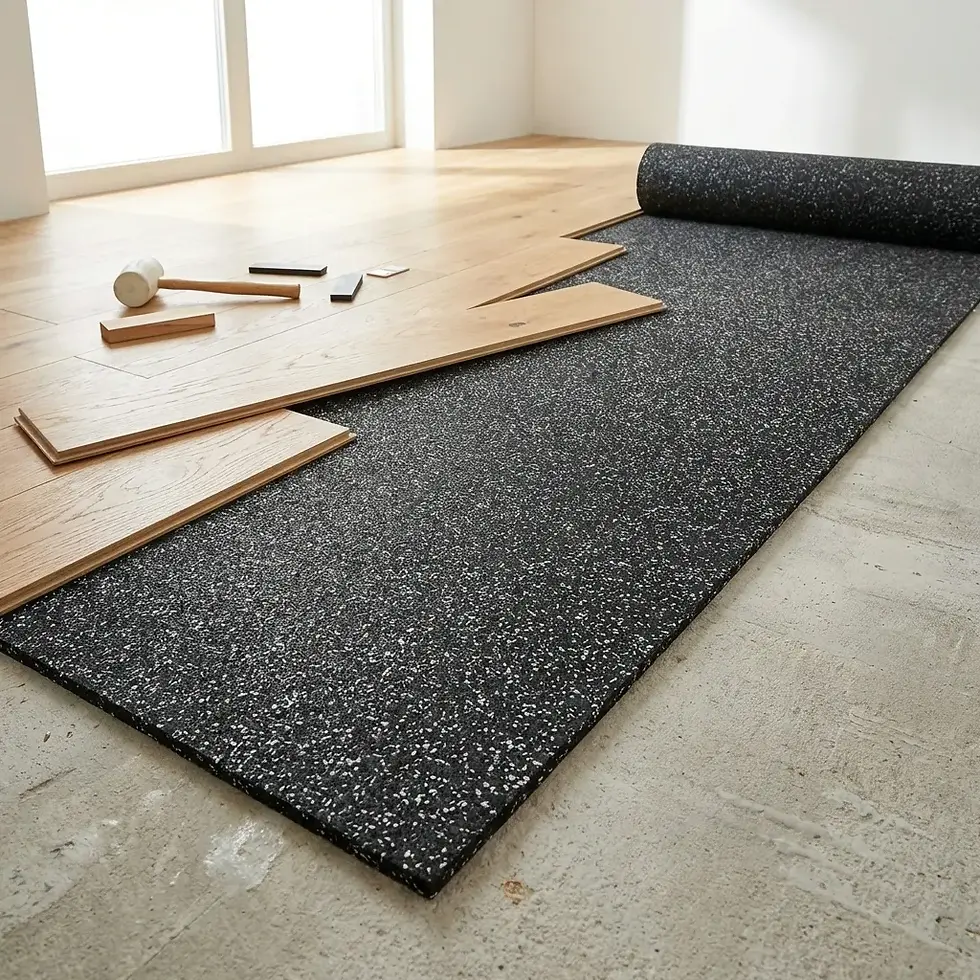
Unlike hybrid flooring, laminate flooring requires a separate floating floor underlay, which must be installed across the prepared subfloor before laying the laminate planks. The underlay provides cushioning, helps reduce impact and transmission noise, and assists with achieving a stable, professional installation.
LAMINATE FLOORING INSTALLATION GUIDE
Imperial Flooring Australia®
This installation guide outlines the correct procedures for installing Imperial Flooring Australia® Laminate Flooring products. Installation must be completed in accordance with these instructions and relevant Australian Standards. Failure to comply may void product warranty.
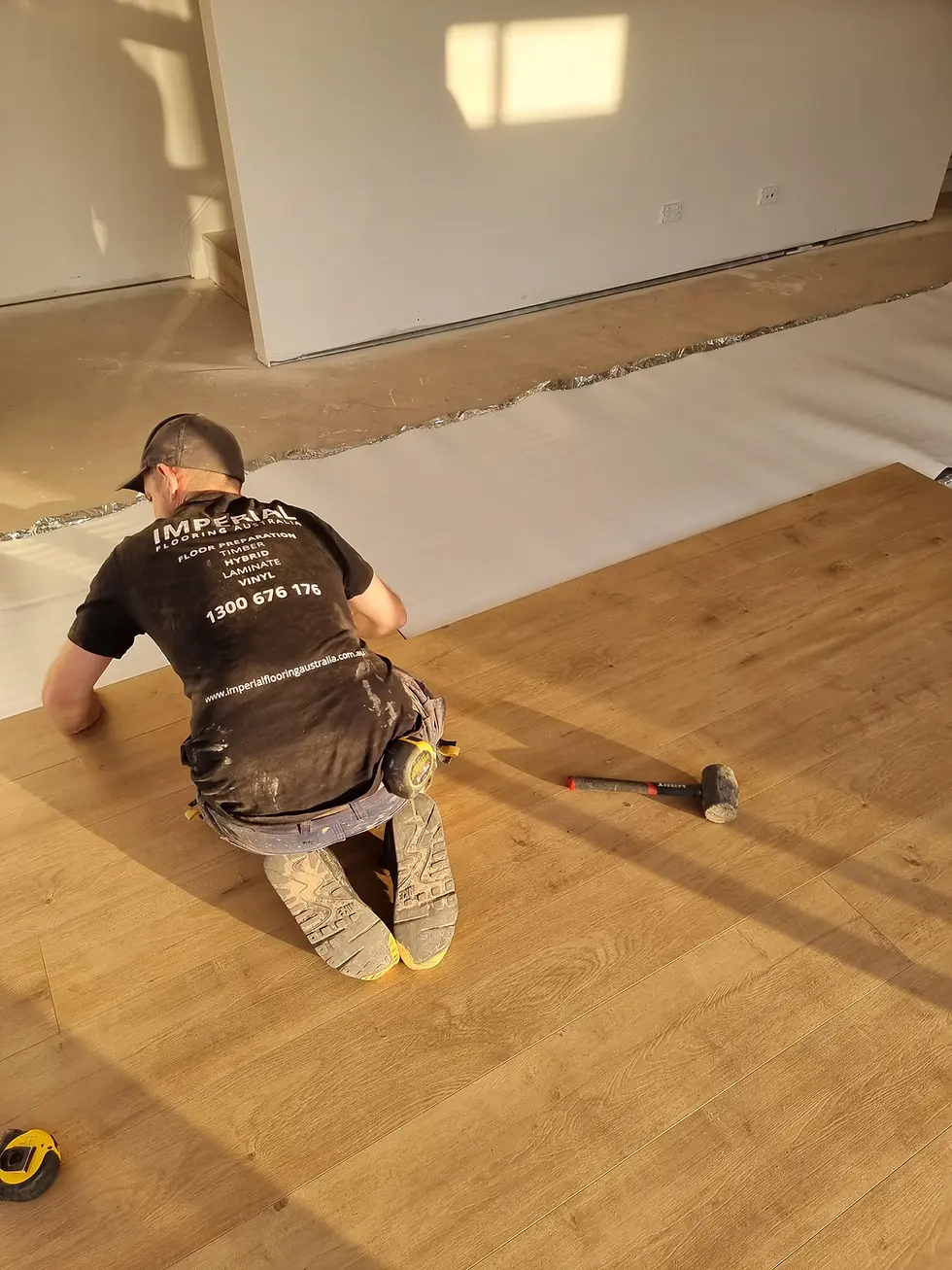
Laminate flooring is a floating floor system and must not be mechanically fixed or glued to the subfloor.
1. Materials and Equipment Required
The following materials and tools are required:
-
Compliant floating floor underlay (as specified)
-
10mm spacers
-
Measuring tape
-
Straight edge (minimum 2m; 3m recommended)
-
Mitre saw or table saw
-
Jigsaw (for detailed cuts)
-
Utility knife
-
Rubber mallet
-
Tapping block
-
Multi-tool (for undercutting door frames)
-
Vacuum and cleaning equipment
2. Subfloor Requirements
Correct subfloor preparation is critical to long-term performance.
The subfloor must be:
-
Structurally sound
-
Dry and moisture compliant
-
Clean and free of debris, adhesives, and contaminants
-
Flat within tolerance
All carpet staples, glue residue, and loose materials must be removed prior to installation.
Flatness Tolerance
-
The subfloor must not exceed: 3mm variation over 3 metres (as per Australian Standards)
-
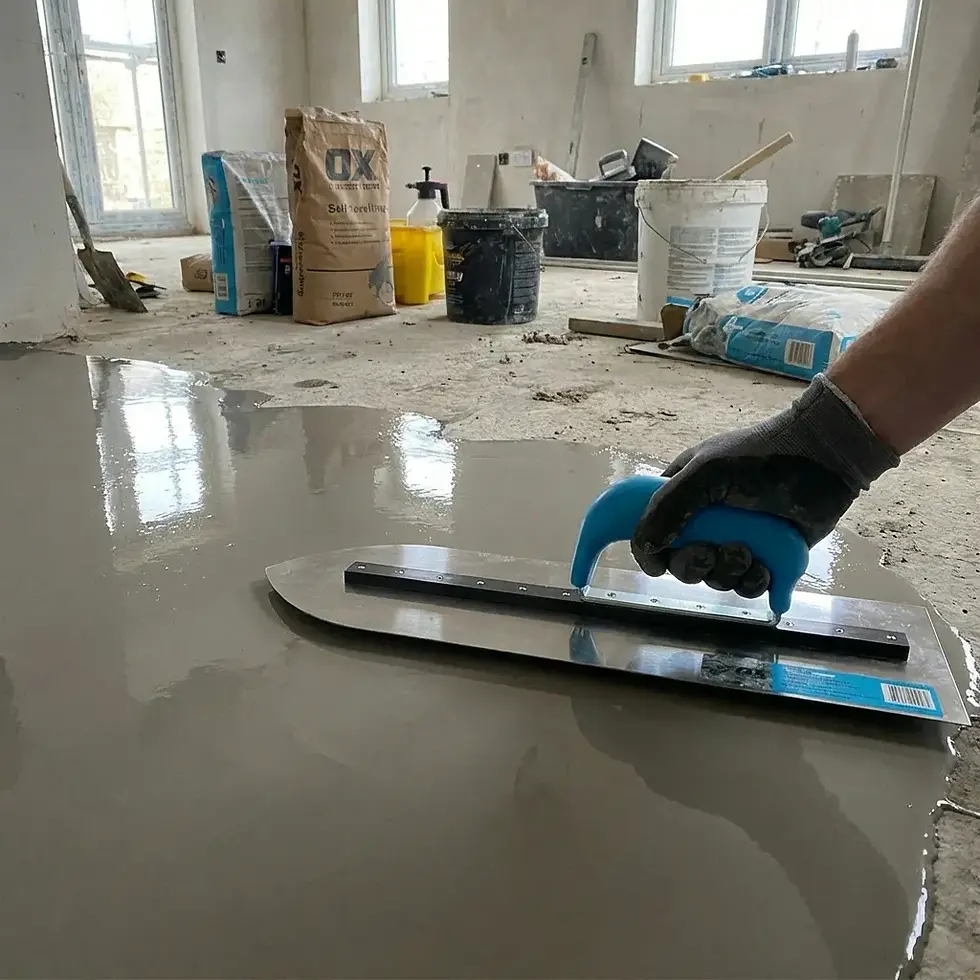
Flatness must be checked using a straight edge. Non-compliant areas must be rectified using approved levelling compounds, grinding, or sanding methods.
-
Failure to meet flatness tolerances may result in joint failure or excessive movement.
3. Underlay Installation
A compliant floating floor underlay must be installed over the prepared subfloor prior to laying laminate planks.
Underlay must:
-
Be suitable for laminate flooring
-
Provide moisture protection where required
-
Be installed in accordance with manufacturer specifications
4. Planning and Layout
Prior to installation:
-
Measure the room carefully.
-
Determine plank direction (generally parallel to the longest wall or natural light source).
-
Plan layout to avoid narrow finishing rows where possible.
All expansion allowances must be accounted for before installation begins.
5. Expansion Requirements
A continuous 10mm expansion gap must be maintained for runs upto 12m.
-
Along all perimeter walls
-
Around fixed objects and penetrations
-
Around columns and cabinetry
-
At transition areas
For installations exceeding 20m x 12m:
-
Install expansion breaks at doorways
-
Imperial Laminate Flooring™ – High Definition has been engineered to accommodate continuous floating floor runs of up to 20 metres. For installations exceeding 12 metres in length and up to 20 metres, a 15mm expansion allowance must be provided to accommodate natural movement of the flooring.
For larger areas exceeding 20m, expansion breaks may be required in accordance with Australian Standards and product specifications.
Skirting boards or scotia must not restrict natural floor movement.
6. Undercutting Door Frames
Door jambs and architraves must be undercut to allow flooring to slide underneath without restriction.
-
Use a laminate plank as a height guide.
-
Undercut using a multi-tool or appropriate cutting equipment.
This ensures correct expansion allowance and a professional finish.
7. Installation Procedure
7.1 First Row Installation
-
Begin installation along the longest straight wall.
-
Cut off the tongue on the wall side of the first row.
-
Insert 10mm spacers along the perimeter.
-
Ensure the first row is straight and aligned, as it determines overall floor alignment.
7.2 Installing Subsequent Rows
-
Angle the plank at approximately 15–25 degrees.
-
Engage the long edge locking system.
-
Lower the plank to secure in place.
End joints must:
-
Have a minimum plank length of 200mm
-
Maintain a minimum stagger of 400mm between adjacent rows
Start each new row with the offcut from the previous row where practical, ensuring stagger requirements are maintained.
Use a tapping block and rubber mallet to close joints. Planks must not be struck directly.
8. Cutting and Fitting
When installing around obstacles such as doorways, cupboards, or fixed units:
-
Measure accurately.
-
Cut using appropriate cutting equipment.
-
Maintain the required 10mm expansion gap around all fixed structures.
9. Completion
Upon completion:
-
Inspect all joints for full engagement.
-
Confirm expansion gaps are unobstructed.
-
Remove spacers prior to installing skirting boards or scotia.
-
Install transition trims where required.
The finished installation must allow unrestricted movement of the floating floor system.
10. Maintenance
To maintain the performance of Imperial Flooring Australia® Laminate Flooring:
-
Clean using a manufacturer-approved cleaner suitable for laminate flooring.
-
Avoid excessive water exposure or wet mopping.
-
Clean spills immediately.
-
Install protective pads under furniture.
Laminate flooring is moisture-resistant but not waterproof.
Disclaimer
Installation must be carried out in accordance with this guide and relevant Australian Standards. Imperial Flooring Australia® accepts no responsibility for failure resulting from improper installation, subfloor non-compliance, site conditions, or failure to maintain required expansion allowances.